Loading
Loading
Many leads aren't ready to buy when they first contact you. A homeowner may be collecting quotes for a project next spring. A business owner may like your proposal but needs approval from a partner. A patient may be researching options before committing. None of them said no. They said "not yet," and most businesses never follow up properly after that.
Automated lead nurturing fills that gap. Done well, it keeps your business in front of people who are still deciding, without your team having to remember every follow-up. Done poorly, it becomes the generic email sequence everyone ignores.
Automated lead nurturing is the use of CRM workflows to send timely, relevant messages to prospects who aren't ready to buy yet, based on what they're interested in and how they behave. The goal is to provide useful information and an easy path back to a conversation when the timing is right, while stopping automatically when a lead replies, books, buys, or opts out.
Nurturing is different from immediate lead response. Speed-to-lead workflows handle the first minutes after an inquiry. Nurturing handles the weeks and months after that.
A traditional drip campaign sends the same messages on a fixed schedule to everyone in a list. A behavior-based lead nurturing workflow adjusts based on what each person does.
| Factor | Fixed drip campaign | Behavior-based nurturing |
|---|---|---|
| Timing | Same schedule for everyone | Adjusts to actions and stated timeline |
| Content | Same messages for every lead | Varies by service interest, stage, and source |
| Stopping rules | Often only on unsubscribe | Stops on reply, booking, purchase, or opt-out |
| Setup effort | Low | Moderate |
| Relevance to the lead | Limited | Higher |
Fixed drips are fine for newsletters. For leads who expressed real interest, behavior-based nurturing usually produces better conversations.
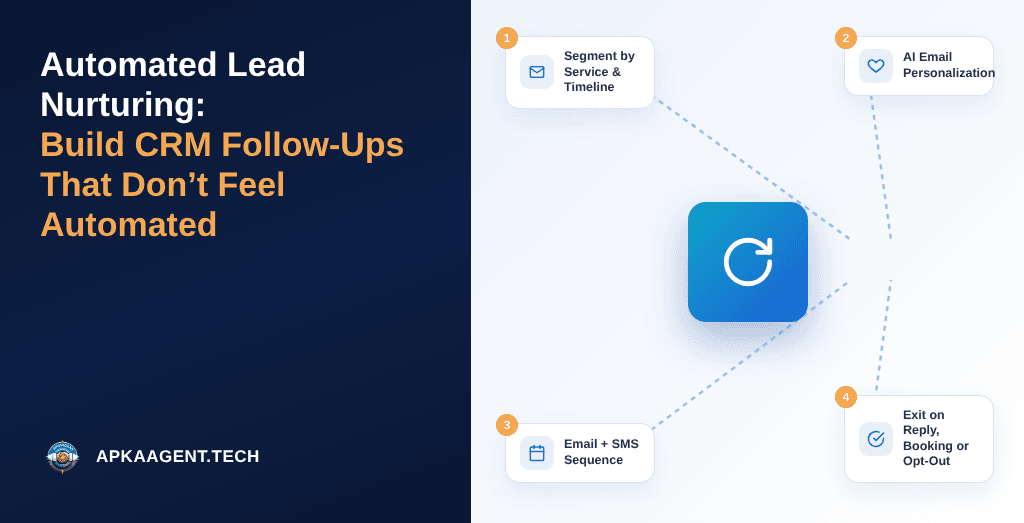
Segment leads by what matters for the next message. For most small businesses, that means the service they asked about, their stated timeline, and where they are in the pipeline. A kitchen remodel lead and a bathroom repair lead shouldn't receive the same sequence.
An email and SMS nurture sequence works best when each channel does what it does well. Email suits longer, useful content such as guides, project examples, and FAQs. SMS suits short, personal check-ins and time-sensitive reminders. Sending long promotional content by text tends to feel intrusive.
Every sequence needs clear exit conditions. A lead who replies should leave automation and go to a person. A lead who books should move to appointment workflows. A lead who opts out must stop receiving messages on that channel immediately.
The best CRM follow-up automation includes tasks for people. After a lead opens several emails or clicks a pricing page, the system can create a call task for a salesperson. Automation should create the right moments for human contact, not replace it entirely.
Here's an example for a home improvement company nurturing a lead who requested a quote but said they plan to start in about three months. Your timing and content will differ, but the structure is a good starting point.
Notice that the sequence follows the lead's timeline, mixes channels, and focuses on being useful rather than repeating "just checking in."
AI adds value to lead nurturing for small businesses in a few specific places.
AI email personalization. Instead of inserting only a first name, AI can tailor an opening line to what the lead actually wrote in their inquiry, such as their project type or concern. Keep the main message approved and consistent, and let AI adjust the parts that benefit from context.
Reply handling. When a nurtured lead replies with a question, AI can classify the reply, answer simple questions from approved information, and route serious buying signals to a salesperson immediately.
Timeline extraction. AI can read free-text answers like "probably after the holidays" and convert them into a date field your workflow can use.
Engagement summaries. Before a salesperson calls a nurtured lead, AI can summarize what that person has opened, clicked, and asked, so the conversation starts with context.
AI shouldn't generate unreviewed messages at scale or make offers your business hasn't approved. Personalization should feel helpful, not invasive. Referencing information a lead didn't knowingly share with you can backfire.
Commercial email in the US must follow the CAN-SPAM Act, which includes requirements such as a working unsubscribe option, accurate sender information, and a physical mailing address. Marketing texts are subject to stricter consent requirements under the Telephone Consumer Protection Act and state laws, and business texting through 10-digit numbers generally requires A2P 10DLC registration.
Deliverability also matters. Sending too often, to people who never engage, or from a poorly configured domain can push your emails into spam folders. Authenticate your sending domain, remove long-unengaged contacts periodically, and keep frequency reasonable.
One sequence for everyone. Generic content signals that nobody actually read the inquiry.
No exit when a lead replies. Few things look worse than an automated "Are you still interested?" message after the customer has already booked.
Sales-only content. If every message asks for a call, people stop opening them. Mix useful information with occasional clear calls to action.
Forgetting old leads. A re-engagement campaign for leads who went quiet months ago is often one of the easiest ways to restart conversations with people who already know your business.
Never reviewing results. Check open rates, reply rates, opt-outs, and booked appointments by sequence. Rewrite or remove messages that consistently underperform.
Most modern CRMs, including GoHighLevel and HubSpot, support nurture workflows with segmentation, wait steps, and conditions. The work that makes them effective is planning segments, writing useful content, setting exit rules, and connecting AI steps safely.
ApkaAgent builds CRM automations and AI-assisted follow-up systems through our CRM automation service. For a broader look at where automation helps a business and where people should stay involved, read what AI automation actually changes in a business. If you want help planning which segments and sequences to build first, our AI consulting service can map it out with you. You can also read what clients say about working with us in the testimonials page.
Automated lead nurturing works when it respects the lead's timeline, delivers useful information, and steps aside the moment a person is needed. Segment by interest and timing, use each channel for what it does best, stop automatically on replies and bookings, and use AI for personalization and reply handling rather than mass messaging.
If your CRM is full of leads that are never heard from again, book a free consultation with ApkaAgent and we'll help you build a follow-up system that runs reliably.
Match the sequence to the lead's buying timeline. A lead planning a purchase in three months might receive messages spread across that period, while a lead with no timeline might move to a low-frequency monthly or quarterly re-engagement track. Quality matters more than length. A few useful, well-timed messages usually outperform a long sequence of generic check-ins.
Use both for different purposes. Email works best for longer content such as guides, examples, and answers to common questions. SMS works best for short personal check-ins and reminders. Marketing texts require stronger consent than email, and business texting generally requires A2P 10DLC registration, so confirm your consent process before adding SMS to nurture sequences.
Base personalization on information the lead knowingly shared, such as their service interest, project details, or questions from their inquiry. Keep core messages approved and let AI adjust openings or examples. Avoid referencing details from tracking or third-party data that the person may not expect you to know. Review AI-generated variations before sending them at scale.
A re-engagement campaign targets leads or customers who haven't interacted with your business for a long time. It usually includes a few messages that offer something relevant, such as a seasonal service, new option, or simple question about current plans. Contacts who still don't respond after the campaign can be moved to a less active list to protect email deliverability.
Yes. Small businesses often benefit most, because every lead is valuable and there's rarely someone dedicated to follow-up. Even a few well-written sequences, segmented by service and timeline, can keep conversations going that would otherwise be forgotten. Start with one sequence for your most common inquiry type and expand once it's working.
We'll build a nurture sequence that respects the lead's timeline, mixes email and SMS, and knows exactly when to stop.
Talk to Us