Loading
Loading
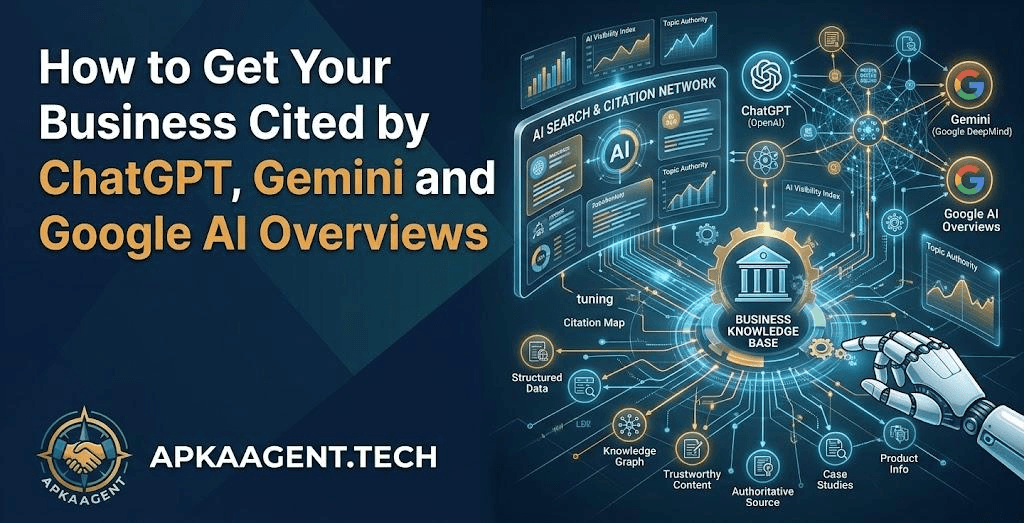
Quick answer: To get cited by ChatGPT, Gemini and Google AI Overviews, publish content that answers specific customer questions directly, structure it with clear headings and FAQs, add schema markup, keep your business details consistent everywhere, and build real proof of expertise. This practice is called generative engine optimization, or GEO.
A growing number of buyers in the US no longer start with ten blue links. They type a question into ChatGPT, ask Gemini, or read the AI Overview at the top of Google, and they act on the short answer they get. If your business isn't in that answer, you may never get the click.
The good news is that small businesses can compete here. AI tools don't only cite the biggest brands. They cite the source that answers the question most clearly. This guide shows how to become that source.
Generative engine optimization is the practice of making your website and brand easy for AI-powered search tools to find, understand, trust and cite when they write an answer. It builds on SEO rather than replacing it. You may also hear it called answer engine optimization, or AEO.
AI search tools pull information from pages they can crawl and understand, then favor sources that answer the question directly, show expertise, and agree with other trusted information online. Google has said its AI Overviews rely on the same core signals as regular search, such as crawlability, content quality and helpfulness.
In practice, the pages that get cited tend to share a few traits:
Start by asking ChatGPT, Gemini and Google the questions your customers ask, and note whether your business appears and which competitors do. Repeat each question a few times, since answers vary.
Try prompts like "best AI automation agency for small business in the US" or "who can build a chatbot for my dental office." Write down who gets mentioned. That list becomes your competitive map.
Answer-first content puts a direct, one-to-three sentence answer right under each heading, then adds detail below. AI tools often lift that opening answer word for word, so it needs to make sense on its own.
Weak opening: "When it comes to automation, there are many factors to consider..."
Strong opening: "A missed call text back automatically texts anyone whose call you didn't answer, usually within seconds, so the lead doesn't call a competitor."
Look at the structure of posts on the ApkaAgent blog: each section opens with the answer, then explains. That pattern is deliberate.
Question-based headings match how people prompt AI tools, which makes it easier for those tools to connect a user's question to your section. An FAQ block at the end of each post covers the follow-up questions people ask next.
Good sources for questions: your sales calls, support emails, Google's "People also ask" box, and the questions customers type into your chatbot.
Schema markup is code that labels your content so machines understand it, for example marking a section as an FAQ, a page as a service, or your business as a local company. The most useful types for small businesses are Organization, LocalBusiness, Service, FAQPage and Article.
Most website builders and SEO plugins can add these without custom code. If you have a custom-built site, your developer can add them in an afternoon.
AI tools and Google both look for signs that a real business with real experience is behind the content. Named authors, project examples, client testimonials and a clear About page all help.
That's why pages like About Us and Testimonials matter for AI visibility, not just for human visitors. Write about what you have actually built and the results you have actually seen.
Use the exact same business name, services, location and contact details on your website, Google Business Profile, social profiles and directory listings. Conflicting details make AI tools less confident about recommending you.
Publishing several connected posts on one subject, and linking them together, signals that your site is an authority on that subject. One isolated article rarely gets cited; a cluster of useful articles often does.
For example, an AI agency might connect a pillar page on what an AI automation agency does with supporting posts on pricing, use cases and tools, plus a page on choosing an AI development company.
Track AI visibility with monthly manual checks of your key questions in ChatGPT, Gemini and Google, along with branded search volume, direct traffic, and leads who say they found you through an AI tool. Add "How did you hear about us?" to your contact form and include "ChatGPT or AI search" as an option.
Yes. GEO and SEO overlap heavily, and good SEO is the foundation for showing up in Google's AI Overviews. GEO adds answer-first writing, stronger structure and more focus on brand mentions and proof. Most of the work helps both at the same time.
| Factor | Traditional SEO | GEO |
|---|---|---|
| Goal | Rank in search results | Be cited inside AI answers |
| Main signal | Relevance and links | Clear answers, structure, trust |
| Measured by | Rankings and clicks | Mentions, citations and branded demand |
It varies. Google AI Overviews can pick up well-structured pages as soon as they rank, while ChatGPT and Gemini may take longer to reflect new content and brand mentions. Expect to work on it over several months.
Yes. AI tools often cite whichever source answers a specific question best. A small business with clear, detailed answers on a narrow topic can be cited ahead of larger companies with vague content.
Content gets cited for being clear, accurate and useful, not for how it was produced. Generic, repetitive content with no real experience behind it rarely performs well in either search or AI answers.
They are close to the same thing. Both describe optimizing content so AI-powered answer engines can find and cite it. Different companies use different names.
Want a website that AI tools can actually read and recommend? ApkaAgent builds fast, well-structured web apps and content systems for small businesses. See our services or get in touch. You may also like our post on what Claude is useful for beyond the chat box.
We build well-structured sites and content systems that AI search tools can actually read and cite. Let's talk.
Talk to Us