Loading
Loading
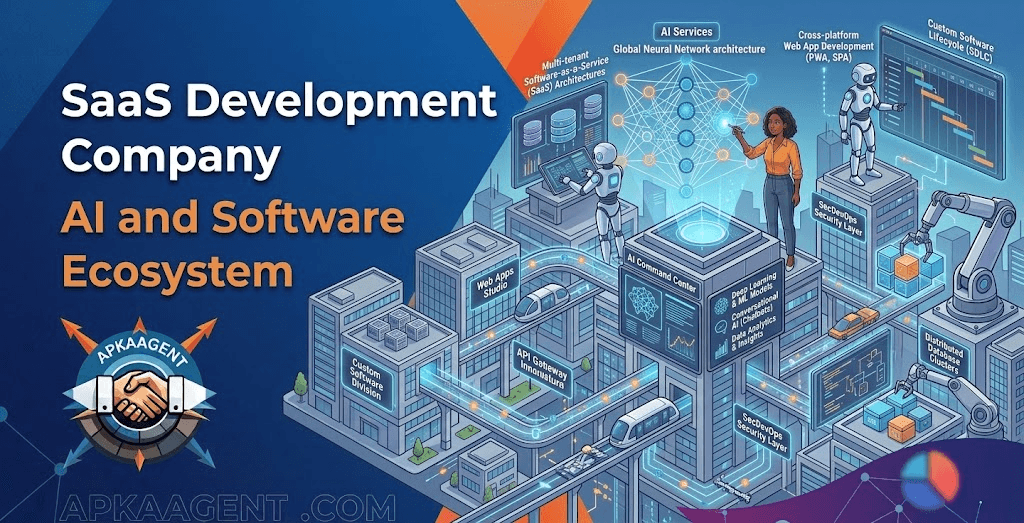
An AI development company builds custom AI systems, SaaS products, web applications, and other custom software for businesses. Rather than offering one fixed product, it works with a business to figure out which technology actually solves its problem, then designs and builds it. That can mean a custom AI model or agent, a subscription SaaS platform, a web application, or software built entirely from scratch.
The line between these categories has blurred. A SaaS product might include AI agents that handle support tickets. A custom web app might need AI-powered search. A business doesn't usually walk in asking for "AI development" or "SaaS development" separately; it walks in with a problem, and the right development partner figures out which combination of technology actually solves it.
This guide covers what an AI development company does, when a business needs custom AI versus SaaS versus a web application versus off-the-shelf software, what these services tend to cost, and how to choose the right partner.
An AI development company designs, builds, and maintains AI-powered software built around a specific business's workflow, rather than a one-size-fits-all product. Core AI development services usually include:
Most businesses looking into AI development land in one of a few common service areas. Custom AI development covers building models or systems tailored to a specific workflow instead of adapting a generic tool. AI automation services handle repetitive tasks, like sorting documents, drafting responses, or updating records, so people don't have to do that work manually. AI consulting helps a business figure out where AI actually fits before any code gets written, which matters because not every process needs AI.
Beyond those three, businesses also commonly need:
A business needs custom AI development when its workflow, data, or decisions are specific enough that an off-the-shelf AI tool doesn't fit well. Signs that custom development makes sense:
When none of that applies, an existing AI tool is usually faster and cheaper than building something custom.
AI development and traditional software development solve different kinds of problems, and the table below lays out where they differ.
| Factor | AI development | Traditional software development |
|---|---|---|
| Logic | Learns patterns from data and produces probabilistic outputs | Follows fixed, explicitly programmed rules |
| Best suited for | Tasks involving unstructured input, like text, images, or judgment calls | Tasks with clear, fixed rules and predictable outcomes |
| Behavior over time | Can improve or drift as data and models change | Behaves the same way until the code is changed |
| Testing | Requires testing across varied, realistic scenarios, since outputs aren't fully predictable | Testing can verify exact expected outputs |
| Ongoing cost | Ongoing model usage costs that scale with usage | Mostly fixed hosting costs after launch |
| Risk of error | Can produce incorrect or inconsistent outputs that need review | Errors are typically bugs, not inherent uncertainty |
SaaS development builds subscription software that many customers use through the cloud, each with their own account and data. A SaaS platform is the product itself, usually sold on a monthly or yearly plan, rather than an internal tool built for one company. AI fits into SaaS products in a few common ways.
A SaaS product doesn't need AI to be worth building. Many successful SaaS platforms run on straightforward, rules-based logic. AI is worth adding when it solves a specific problem for the platform's users, not as a default feature.
Web application development builds software that runs in a browser rather than as a standalone subscription product. The distinction between a web app and a SaaS platform matters: a web app might serve one company's internal team or a single client's specific needs, while SaaS serves many separate customers through one shared platform. Common web application development services include:
A custom software development agency builds software of any kind, not necessarily involving AI; an AI development company specializes specifically in AI-powered systems. In practice, the lines overlap heavily, since many agencies, including ApkaAgent, cover both. The more useful question for a business isn't which label a company uses, but whether the company can honestly tell you when AI is the right fit and when it isn't, rather than pushing AI into every project regardless of whether the problem calls for it.
These categories aren't competing choices. Most real projects combine them. Here's a hypothetical example of how that might play out for a business building a customer service platform.
ApkaAgent's own product, JobzseekerAI, is an example of this kind of combination: a SaaS platform with multiple AI agents handling different parts of the hiring workflow, from categorizing CVs to matching candidates to opportunities to scheduling meetings between both sides.
There's no fixed price for AI development, because cost depends heavily on scope. ApkaAgent doesn't publish fixed pricing; actual cost depends on the specific project. The main factors that drive cost are:
The right AI development company is honest about when AI fits and when it doesn't, has relevant experience, and is clear about cost, ownership, and support from the start. Use this checklist:
ApkaAgent is a software development agency with an in-house team covering custom AI development, AI agents and automation, SaaS platforms, web applications, and AI consulting. You can review ApkaAgent's projects or read more about the team on the About Us page.
Building custom software instead of buying an existing product makes sense when:
When none of those apply, buying or subscribing to existing software is almost always faster and cheaper than building custom.
The right AI development company for your business depends on your specific problem, not on which buzzwords a vendor uses. Start by defining the problem clearly, then look for a partner who can tell you honestly whether AI, SaaS, a web application, or plain custom software is the right fit, and who will still be there after launch. If you're weighing a project, you can talk to the ApkaAgent team about scope and next steps, or read more about what AI automation actually changes in a business before deciding how much AI to build in.
An AI development company designs, builds, and maintains custom AI systems, such as AI agents, custom models, and AI-integrated software, tailored to a specific business's workflow rather than offering one fixed product.
AI development builds systems that learn patterns from data and produce probabilistic outputs, suited to unstructured input like text or images. Traditional software development follows fixed, explicitly programmed rules with predictable outcomes.
Custom AI makes sense when the workflow is specific to the business, existing tools require too many workarounds, the business has proprietary data, or accuracy and security requirements are too high for a generic tool.
Yes. AI features such as automated tagging, summarization, predictive alerts, or AI agents can be added to SaaS platforms or web applications, as long as the underlying data and systems are accessible to connect to.
Cost depends on the complexity of the AI task, how much custom model work is needed, integrations, data preparation, security requirements, testing, and ongoing model usage and maintenance costs. There's no fixed price.
A custom software development agency builds software of any kind, not necessarily involving AI. An AI development company specializes in AI-powered systems. Many agencies, including ApkaAgent, cover both.
No. AI is worth adding when it solves a specific problem involving unstructured information or judgment calls. Many successful products run on straightforward, rules-based logic without AI.
Look for a company that's honest about when AI fits and when it doesn't, has relevant experience, is clear about data security and integrations, and defines cost, ownership, and support in writing before starting.
We build custom AI, SaaS platforms, and web applications, and we'll tell you honestly which one your problem actually needs.
Talk to Us