Loading
Loading
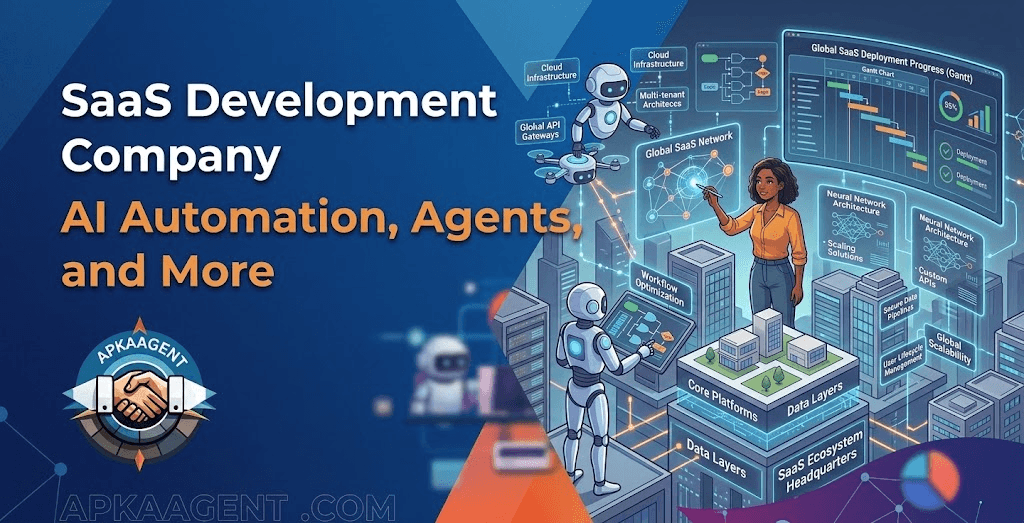
A SaaS development company plans, builds, launches, and maintains software that customers use online through a subscription. Instead of installing anything, your customers log in through a browser, pay monthly or yearly, and get updates automatically. The company building it handles everything behind that login screen: the architecture, the database, user accounts, billing, security, and cloud hosting.
That's what separates a SaaS product from an ordinary website or a simple web app. A website shares information. A basic web app might serve one company's internal team. A SaaS platform serves many separate customers at once, each with their own account, data, and settings, and it has to handle subscriptions, permissions, and growth without breaking.
Many SaaS products now go further, with AI automation that handles repetitive work inside the product, AI agents that complete multi-step tasks, and, in a smaller number of cases, blockchain features for things like smart contracts or digital assets. This guide covers what SaaS development involves, when it makes sense, and how to decide which of these technologies your product actually needs.
A SaaS development company turns a product idea into working cloud software that many customers can use at the same time. SaaS development services usually cover the full lifecycle, from planning to long-term maintenance.
ApkaAgent's SaaS development services cover cloud-based builds with multi-tenant architecture, subscription management, analytics dashboards, and billing systems.
Build a SaaS product when many customers share the same recurring problem and would pay regularly for software that solves it. The subscription model only works if the problem keeps coming back.
SaaS tends to make sense when you have:
A practical example: a company that manages HVAC service contracts realizes other HVAC businesses struggle with the same scheduling and maintenance tracking. Turning that internal process into a SaaS product could create a new revenue line.
SaaS may not be necessary when the software only serves your own team, when the problem is one-time, or when an existing product already solves it well at a reasonable price. In those cases, an internal tool or custom web application development is usually faster and cheaper than building subscription billing and multi-customer architecture you don't need.
Custom SaaS development means building a subscription software product from the ground up around your own workflows and business model, instead of buying or adapting someone else's software. There are three common paths:
| Option | What it means | Works best when |
|---|---|---|
| Buy existing software | Subscribe to a tool that already exists | Your needs are standard and a good product already covers them |
| Customize an existing platform | Configure, extend, or build on top of a platform you already use | You need some changes but the core platform fits |
| Build a custom SaaS product | Design and develop your own platform | Your workflow is unique, or the software itself is the product you plan to sell |
Custom SaaS platform development usually involves a few pieces that non-technical founders should understand:
Most founders don't build everything at once. SaaS MVP development focuses on a minimum viable product: the smallest version that solves the core problem well enough for real customers to use and pay for. It lets you test demand before investing in every feature.
AI automation improves a SaaS product by handling the repetitive work your users would otherwise do by hand, especially work that involves reading text, sorting information, or making routine decisions. This matters most for products sold to smaller companies, since AI automation for small business customers often means doing the job of an extra employee they can't afford to hire.
Practical examples inside a SaaS product:
AI adds real value when the input is unstructured, such as free-text messages, documents, or varied customer requests. When the logic is fixed ("when an invoice is paid, mark the account active"), simple automation is enough. It's cheaper, faster, and more predictable. Adding AI to a step that doesn't need it raises your running costs and introduces mistakes that rules wouldn't make. Our post on what AI automation actually changes in a business goes deeper into this tradeoff.
AI workflow automation services connect your SaaS product with the other systems your business or your customers rely on, and use AI to handle the steps that need judgment. Typical connections include SaaS applications, CRM systems, email, databases, internal tools, customer support platforms, and third-party APIs.
Here's a hypothetical example of how AI workflow automation might handle new leads for a SaaS company:
This kind of business automation depends on reliable API integrations. If your CRM, email platform, and product database can't share data cleanly, the workflow breaks. That's why integration work is often the bulk of the effort, not the AI itself. ApkaAgent's AI automation services include workflow automation, integration setup, and maintenance plans, and the company works with tools such as Zapier, n8n, and Make.com alongside custom code.
There's no universal AI agent development cost, because the price depends on what the agent does, what it connects to, and how carefully it needs to be controlled. ApkaAgent doesn't publish fixed pricing; actual development cost depends on scope and requirements.
The main cost factors are:
Projects also differ by type:
| Agent type | What it does | Relative effort |
|---|---|---|
| Simple task-focused agent | One job, such as answering support questions from documentation | Lowest |
| Workflow agent | Runs a defined business process, such as lead intake to booked demo | Moderate |
| Multi-step agent | Plans and adjusts across longer tasks with less direction | Higher; needs stronger guardrails |
| Multi-agent system | Several specialized agents passing work between them | Highest; needs coordination, monitoring, and testing |
ApkaAgent's own product, JobzseekerAI, is an example of a multi-agent system inside a live platform: one agent categorizes uploaded CVs, another matches candidates to opportunities, and a third handles connecting both sides and scheduling meetings. For SaaS founders thinking about AI agents for business users, the lesson is to start with one focused agent and expand only once it proves reliable.
A business needs a blockchain development company when it requires records or transactions that several parties must trust without relying on one central owner, or when it's building something that depends on smart contracts or digital assets. Most SaaS products don't need blockchain at all.
Blockchain development services can involve:
Blockchain may solve a real problem when multiple organizations need a shared record none of them controls alone, or when transparent, automatic execution of agreements is the core of the product. A traditional database is usually the better choice when one company owns the data, when you need fast and cheap edits, or when customers just need reliable records. Databases are faster, simpler, and easier to change. ApkaAgent offers blockchain development services covering smart contracts, DeFi platforms, NFT systems, and cryptocurrency integration, but blockchain should be chosen for a specific reason, not because it sounds modern.
SaaS, AI automation, AI agents, and blockchain solve different problems, and many products need only one or two of them. Use this table to match the technology to the problem.
| Technology | What it's designed to solve | Good fit | Not needed when |
|---|---|---|---|
| SaaS | Delivering software to many customers by subscription | Recurring problems shared by many businesses | Only your own team uses it, or the need is one-time |
| AI automation | Handling repetitive tasks that involve reading or sorting information | Emails, documents, tickets, and data classification | Fixed rules already handle the task reliably |
| AI agents | Completing multi-step tasks with routine decisions | Lead handling, support resolution, scheduling | The process is simple or too high-risk to delegate |
| Blockchain | Shared, tamper-resistant records and automatic agreements | Multi-party transactions, smart contracts, digital assets | One company owns the data and a database works fine |
A good rule: start from the problem, then pick the simplest technology that solves it. Choosing technology because it's popular is one of the most expensive mistakes in software projects.
Here's a hypothetical example of how they can fit into one product without forcing any of them.
A startup builds a SaaS platform for freelance contractors and the companies that hire them. The SaaS platform is the core product: companies post projects, contractors apply, and both sides manage contracts, invoices, and messages in one place. AI automation handles repetitive work, such as sorting applications, extracting details from uploaded documents, and sending payment reminders. An AI agent takes on more flexible tasks, like answering contractor questions, matching applicants to projects, and scheduling interviews, with a human reviewing final hiring decisions. Blockchain is added only for one specific feature: smart-contract-based milestone payments, where both parties want automatic, transparent release of funds when work is approved. Everything else stays in a standard database.
The point of the example is restraint. Each technology has a clear job, and none is there just to sound impressive.
The right partner understands your business problem, has done similar work, and is clear about scope, ownership, and support from the start. Use this checklist:
ApkaAgent is a software agency with an in-house team covering SaaS platforms, AI agents and automation, custom AI development, web applications, blockchain, and AI consulting. Its process starts with a call about your goals, moves to a working session where requirements are defined and an MVP architecture is proposed, and continues through build, testing, deployment, and ongoing support. You can review ApkaAgent's projects to see the kind of custom software development the team does.
A good SaaS development company helps you build the product your customers need first, then adds AI automation, agents, or blockchain only where each one solves a real problem. Start with a focused MVP, plan for security and scale, and choose a partner who will still be there after launch. If you're weighing a SaaS idea, you can talk to the ApkaAgent team about scope and next steps.
A SaaS development company plans, designs, builds, and maintains subscription-based cloud software. That includes product architecture, UI/UX, backend development, APIs, databases, user accounts, billing, dashboards, cloud deployment, security, and ongoing maintenance.
Custom SaaS development cost depends on scope: the number of features, integrations, user roles, billing complexity, security requirements, and design work, plus hosting and maintenance after launch. Starting with an MVP keeps the first investment focused.
It depends on the product's scope and complexity. A focused MVP with core features takes far less time than a full platform with many integrations and advanced features. A clearly defined first version is the best way to keep the timeline predictable.
Yes. AI automation can be added to new or existing SaaS platforms for tasks like customer support, document processing, data classification, reporting, and email handling, as long as the platform's data and APIs are accessible.
There's no fixed AI agent development cost. It depends on the agent's complexity, number of tasks, integrations, AI usage, data access, security, approval steps, monitoring, testing, and maintenance. A simple single-task agent costs much less than a multi-agent system.
AI workflow automation services connect business systems, such as SaaS apps, CRMs, email, databases, and support tools, and use AI for steps that need judgment, like qualifying leads or reading documents, with human review where needed.
A business needs a blockchain development company when it requires shared, tamper-resistant records among multiple parties, smart contracts, token-based systems, or digital asset features. For most SaaS products, a traditional database is simpler and more appropriate.
No. AI should be added where it handles unstructured information or routine decisions better than fixed rules. If simple automation does the job reliably, it's usually cheaper and more predictable than adding AI.
We build SaaS platforms, and add AI automation, agents, or blockchain only where they actually solve something. Let's talk through your idea.
Talk to Us