Loading
Loading
A homeowner fills out your quote form at 9:40 p.m. Your team sees it at 8:30 the next morning. By then, the homeowner has also contacted two competitors, and one of them had already replied. This happens constantly, and it's rarely because a business doesn't care. It's because people sleep, take weekends off, and get busy.
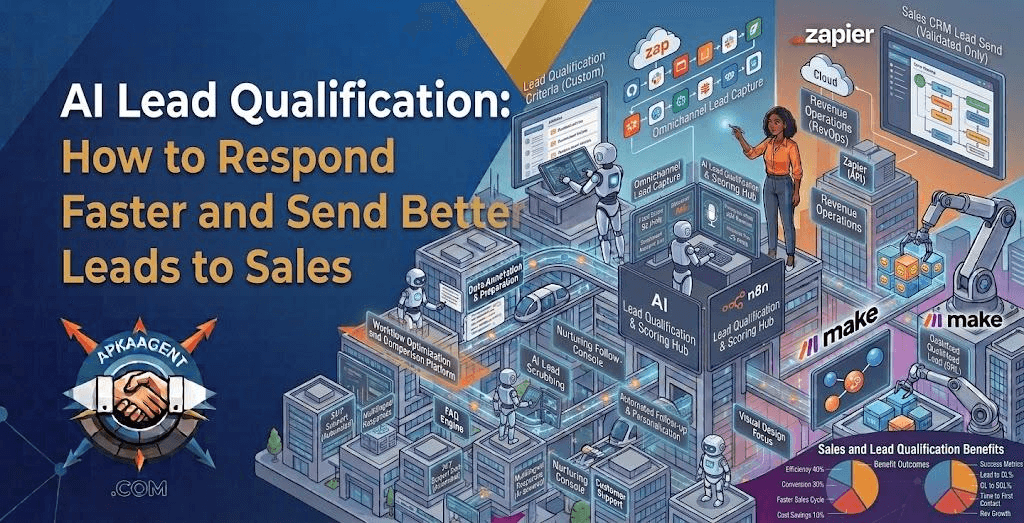
AI lead qualification closes that gap. It responds to new inquiries within moments, asks the questions your best salesperson would ask, scores the lead against your criteria, and sends the strongest opportunities to the right person with context already attached.
The most widely cited research on this topic comes from a 2011 Harvard Business Review study of about 1.25 million sales leads at 42 US companies. Firms that tried to contact a lead within an hour were nearly seven times as likely to qualify that lead, meaning to have a meaningful conversation with a decision-maker, as firms that waited even one more hour. They were more than 60 times as likely as firms that waited 24 hours or longer.
The study is more than a decade old and buying habits have changed since then, but the core lesson has held up: interest fades quickly, and the business that responds first has an advantage. The same research found that many delays were structural, caused by how leads were pulled from systems and distributed, not by lack of effort.
AI lead qualification is the use of AI to engage, assess, and route inbound leads automatically, based on criteria your business defines. A typical system handles six jobs:
AI can't qualify leads against criteria you haven't defined. Many sales teams know a good lead when they see one but have never written down why. Start there. Classic frameworks like BANT (budget, authority, need, timeline) are a useful starting point, but your criteria should reflect your actual business.
Here's how a residential roofing company might translate its criteria into questions and scoring rules:
| Criterion | Question the AI asks | How it's scored |
|---|---|---|
| Service area | What's the property's ZIP code? | Outside the service area: politely decline and close |
| Need | Is this a repair, a full replacement, or storm damage? | Replacement and storm damage score higher |
| Timeline | When are you hoping to have the work done? | Within 30 days scores highest |
| Decision-maker | Are you the homeowner? | Non-owners routed for follow-up with the owner |
| Insurance | Are you filing an insurance claim? | Claims routed to the rep who handles insurance work |
Leads that don't qualify shouldn't simply vanish. Send a respectful response, offer a referral or a helpful resource if you have one, and keep a record. Those contacts may qualify later.
Consider a B2B IT services firm that receives inquiries through its website and LinkedIn ads:
No one worked late, and the prospect felt attended to within minutes. Lower-scoring leads in the same system might go into a nurture sequence or a weekly review queue instead of the director's calendar.
Your CRM should remain the single source of truth. The AI writes to it, and your team works from it. Whether you use GoHighLevel, HubSpot, Salesforce, or something else, the integration needs careful field mapping, duplicate detection so returning contacts aren't created twice, and clear pipeline stages so everyone knows what "AI-qualified" means.
If you're still deciding which part of your sales process to automate first, our breakdown of what AI automation actually changes in a business explains why lead intake is often a strong first candidate: it runs frequently, inputs are fairly consistent, and mistakes are usually easy to catch.
Automated outreach is regulated in the United States, so build compliance in from the start. This isn't legal advice, and you should confirm requirements with a qualified attorney, but these are the major areas to review:
Asking too many questions. Every extra question loses some prospects. Ask only what you need to route the lead, and let the salesperson handle the rest.
Hiding how scoring works. If reps don't understand why a lead was scored high or low, they won't trust the system. Keep the criteria visible and explainable.
No fast lane for hot leads. A prospect who says "I need this fixed today" should reach a person immediately, not finish a questionnaire.
Setting it and forgetting it. Services, pricing, and target customers change. Review criteria and messages every quarter.
AI lead qualification uses AI to respond to inbound leads, gather information through conversation, score each lead against your criteria, and route qualified prospects to the right salesperson, usually with everything recorded in your CRM.
Accuracy depends on how clearly your criteria are defined and how well the system is tested against real past leads. Clear, rule-based criteria combined with AI conversation handling tends to be more reliable than vague "lead quality" judgments. Regular reviews of rejected leads help catch errors.
Yes. AI voice agents can answer calls and ask qualifying questions. Outbound AI calls in the US are subject to TCPA rules, including consent requirements, so get legal guidance before launching phone outreach.
In most cases, yes. Popular CRMs, including GoHighLevel, HubSpot, and Salesforce, offer APIs that allow AI systems to create and update records. Older or custom systems may need additional integration work.
No. Small teams often benefit most, because they have the fewest people available to answer leads after hours. A business with one salesperson can still respond to every inquiry within minutes.
AI lead qualification doesn't replace your sales team. It makes sure your team spends its time on prospects who are ready to talk, with the context needed to have a good first conversation. Start by writing down what makes a lead qualified, connect the system to your CRM, and measure the results honestly.
ApkaAgent builds AI agents and workflow automation for lead intake, scheduling, and CRM updates, and works with platforms including GoHighLevel, Zapier, n8n, and Make.com. You can browse our full range of services or see the kinds of systems we build on our projects page. If you'd like help defining your qualification criteria or connecting your CRM, talk to the ApkaAgent team.
We'll help you define what "qualified" means for your business and connect it to your CRM. Let's talk through your lead flow.
Talk to Us