Loading
Loading
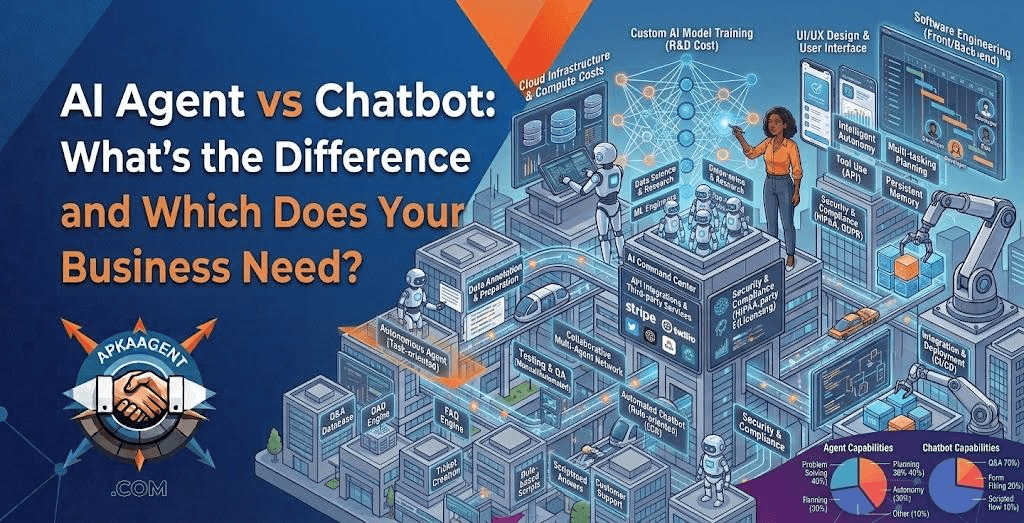
The two terms get used interchangeably in sales pitches, but an AI agent and a chatbot are built for different jobs. A chatbot holds a conversation. An AI agent works toward a goal: it can decide which steps to take, use tools like your calendar or CRM, and finish a task instead of just talking about it.
That difference matters when you're deciding what to buy or build. Choose a chatbot when you really need an agent, and customers get polite answers but no outcomes. Choose an agent when a chatbot would do, and you pay for complexity you don't need.
A chatbot is software that responds to messages, either by following scripted rules or by generating replies with a language model. An AI agent is software that uses a language model to reason about a goal, choose actions, call external tools, and carry out multi-step tasks with some independence. Put simply, a chatbot answers and an agent acts.
The original chatbots work like a phone menu in text form. They follow decision trees, offer buttons, and match keywords to prewritten responses. They're predictable and inexpensive, which is their strength. Their weakness is rigidity: phrase a question in a way the designer didn't anticipate, and the bot loops back to "Sorry, I didn't understand that."
Modern chatbots use a large language model to understand natural phrasing and write responses on the fly. The better ones are grounded in your own content, such as help articles, policies, and product details, so their answers reflect your business rather than general internet knowledge. They handle variety far better than rule-based bots. But most of them still stop at answering. They tell a customer how to reschedule; they don't reschedule.
An AI agent adds the ability to take action. Most business agents share five building blocks:
Agents typically work in a loop: plan a step, take an action, check the result, and decide what comes next. That loop is what lets them complete tasks with several moving parts.
| Rule-based chatbot | AI chatbot | AI agent | |
|---|---|---|---|
| Primary job | Route users through fixed options | Answer questions in natural language | Complete tasks toward a goal |
| Understands varied phrasing | Poorly | Well | Well |
| Access to business systems | Rarely | Limited, often read-only | Yes, read and write through integrations |
| Multi-step tasks | Only scripted paths | Limited | Yes |
| Risk when wrong | Low – a dead end | Moderate – a wrong answer | Higher – a wrong action |
| Setup effort | Low | Moderate | Higher |
| Best for | Simple menus and routing | FAQs and information requests | Workflows that need lookups, decisions, and updates |
Imagine a patient messages a dental office: "I need to move my Thursday cleaning to next week, mornings if possible."
A rule-based chatbot shows a menu: Hours, Location, Insurance, Contact Us. The patient taps "Contact Us" and gets a phone number. The office still has to handle the request by hand.
An AI chatbot understands the request, explains the office's 24-hour rescheduling policy, and shares a link to the online booking page. Better, but the patient still does the work.
An AI agent verifies the patient's identity, finds the existing appointment, checks open morning slots next week, offers two options, books the one the patient picks, updates the practice management system, and sends a confirmation. If the patient asks whether insurance covers a second cleaning this year, the agent passes that question to staff with the conversation attached.
In a healthcare setting like this one, the agent would also need to be built with HIPAA requirements in mind, which affects how data is stored, logged, and shared with AI providers.
In practice, many systems sit between the two labels. An AI chatbot with a single read-only tool, like order-status lookup, is already partway to being an agent. An agent that drafts actions for a person to approve is less autonomous than one that acts directly. Most businesses start in the middle and give the system more responsibility as it proves reliable.
The term "conversational AI agent" describes the common middle ground: a chat or voice interface on the front end with real task-handling ability behind it. Conversational AI agents, process automation, and multi-platform integration are all part of ApkaAgent's AI agents and automation services.
That third point is easy to overlook. Some of the most valuable agents never talk to a customer. As we noted in our look at what Claude is useful for beyond the chat box, much of the practical value of modern AI models shows up inside workflows, not chat windows.
Larger workflows sometimes use a multi-agent system, where specialized agents each own one step and hand off to the next. ApkaAgent's JobzseekerAI marketplace is built this way, with separate agents for CV categorization, candidate matching, and meeting scheduling.
Because agents act, their mistakes cost more than a chatbot's. A wrong answer can be corrected in the next message; a wrong booking, refund, or record update creates real cleanup work. Responsible agent design includes:
A chatbot responds to messages, while an AI agent pursues a goal by choosing and taking actions, such as checking a calendar, updating a CRM, or sending a confirmation. Chatbots answer questions; agents complete tasks.
Often, yes. If your chatbot already uses a language model, adding integrations with your business systems, plus guardrails and handoff rules, can turn it into an agent. Rule-based bots usually need to be rebuilt rather than upgraded.
They can be designed to act independently, but most business deployments shouldn't be fully autonomous. Well-designed agents handle routine cases on their own and escalate unusual, sensitive, or high-risk situations to a person.
Usually, yes. Agents require integrations, more testing, and stronger safeguards. Whether the extra cost is worthwhile depends on how much manual work the agent removes from your team.
Agentic AI refers to AI systems that can plan and carry out multi-step tasks with some independence, rather than producing a single response to a single prompt. AI agents are the practical application of agentic AI in business workflows.
If your customers mainly need answers, a well-grounded AI chatbot may be all you need. If they need things done, like appointments moved, orders checked, or requests routed, you need an agent with the right integrations and the right limits. The best way to decide is to list your most common requests and mark which ones end with information and which end with an action.
For a sense of how a support-focused agent is structured, see our Orbit Agent example project, which illustrates a 24/7 conversational front line for support. And if you'd like help deciding where your business sits on the chatbot-to-agent spectrum, schedule a free consultation with ApkaAgent.
We'll walk through your most common requests with you and help you decide where you actually sit. Let's talk.
Talk to Us